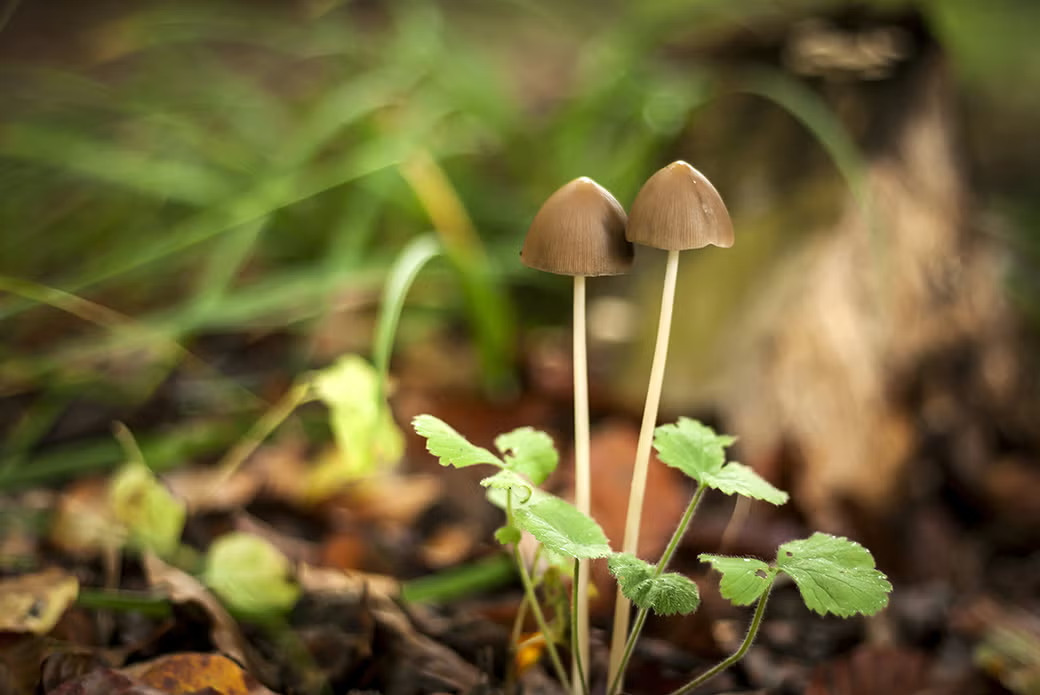
Food can get seriously strange on mushrooms. A strawberry might taste sacred, pizza might feel suspicious, and texture can suddenly become the whole event. That’s because psilocybin changes more than visuals, it affects attention, body awareness, emotional meaning, and how the brain combines taste, smell, texture, and memory. In this post, we break down why food feels so weird during a trip, why fruit often hits just right, and why mushroom chocolate makes so much sense.
Tag Archives: Weird
Adult Swim’s Common Side Effects asks what would happen if a mushroom could cure everything. Researchers are quietly asking the same question.
The Blue Angel Mushroom is fiction. A mycologist finds it in Peru, brings it back to New York, and big pharma immediately tries to bury it. Chaos ensues. It’s one of the best animated shows in years — funny, strange, and sharper about pharmaceutical power than most prestige dramas. But here’s the thing: the science behind the premise is not entirely made up.
People come back from a trip different. Softer. More curious. Kinder to strangers on the subway. Less likely to lose their temper over nothing. The cynic’s response is obvious — of course people say that. Confirmation bias, expectation, the warm glow of a good weekend. Except the research keeps finding that something actually changed. Not for everyone. Not always dramatically. But measurably, replicably, and sometimes for a very long time.
It used to be that admitting you’d taken mushrooms was a career liability — the kind of thing you said quietly to close friends or not at all. Now it’s a profile piece in a major magazine. A chapter in a memoir. A podcast moment that goes viral before the episode finishes downloading. From Elon Musk to Prince Harry to Kristen Bell, the celebrity psychedelic confessional has arrived — and what they’re all saying, when you line it up, is surprisingly consistent: it helped. It changed something. I’m not who I was before.
I expected to become one of those people — sharper in meetings, warmer with strangers, sleeping eight hours without the ambient dread that usually wakes me up at 3am convinced I’ve forgotten something important. I expected a gentle, cumulative upgrade. A software update for a brain that had been running the same slightly buggy version for 27 years. I did not become one of those people. What happened instead was stranger, more boring, more useful, and significantly harder to put in an Instagram caption.
There’s a moment that happens on mushrooms — usually somewhere between the onset and the peak — where the walls start feeling like a bad idea. Not threatening, exactly. Just wrong. Too flat. Too still. Too inside. Then you step outside, and the air hits you, and the trees are doing that thing where they’re just being trees, and something in your chest unlocks. It happens to almost everyone. And it isn’t random.
Nobody tells you that the playlist matters more than the dose. A 2018 study out of Imperial College London found that the quality of a person’s music experience during psilocybin therapy was a stronger predictor of reduced depression than how hard they actually tripped. The music wasn’t background noise. It was the medicine. Here’s what people are actually listening to — and why it matters more than you think.
The first time is unforgettable. You didn’t know what to expect, so your brain had nothing to defend against. The visuals hit differently when you’ve never seen geometry breathe before. Then you went back — same mushrooms, same couch, same carefully assembled playlist — and something was off. Flatter. More work. Less magic.
What happened? Your brain remembered. And remembering, it turns out, changes everything. From receptor downregulation to the neuroscience of expectation, here’s exactly why your second trip felt nothing like your first — and what to do about it.
Struggling to sleep after a mushroom trip is more common than most people expect. Even when the visuals fade and your body feels tired, psilocybin can leave the brain unusually alert. That’s because it stimulates serotonin receptors and increases neural connectivity rather than calming the nervous system. The good news? Post-trip insomnia is usually temporary — and there are simple, science-backed ways to help your body wind down naturally.
Many people are surprised to discover that magic mushrooms don’t make them sleepy — they make it harder to sleep. Even after the main effects fade, the mind often feels alert, reflective, and unwilling to power down. That’s because psilocybin stimulates serotonin receptors and increases overall brain connectivity rather than depressing the nervous system. If you’ve ever felt exhausted but mentally awake after a trip, there’s a clear neurological reason why.