
Why Do I Want to Be Outside on Mushrooms?
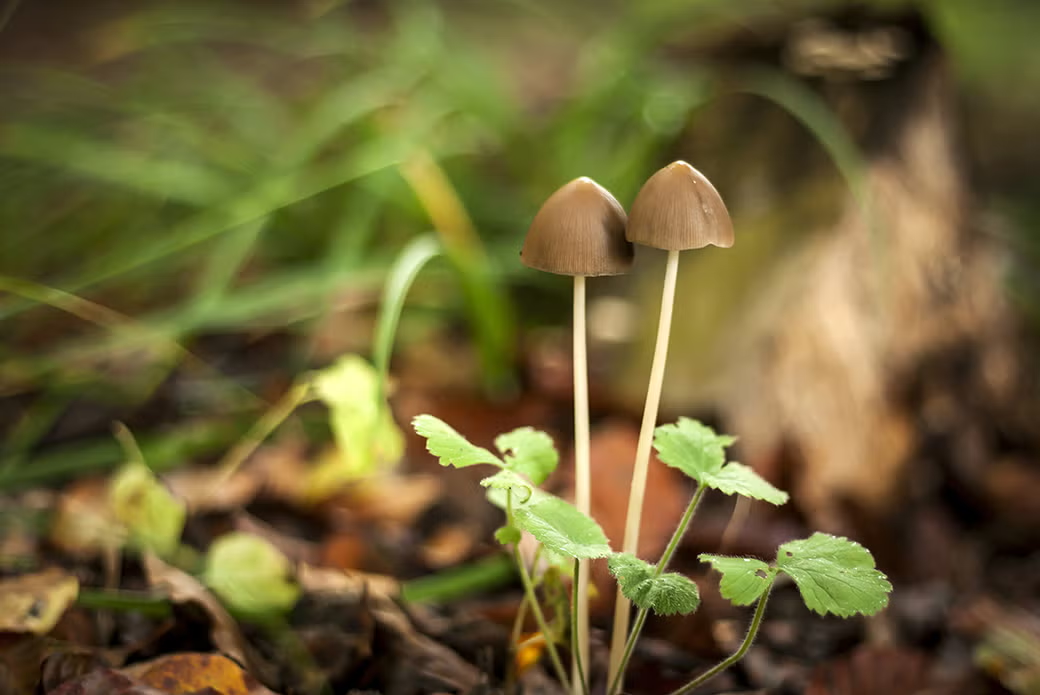
Nature, awe, and the neuroscience behind why the forest feels like home.
There’s a moment that happens on mushrooms, usually somewhere between the onset and the peak, where the walls start feeling like a bad idea.
Not threatening, exactly. Just wrong. Too flat. Too still. Too inside.
And then you step outside, and the air hits you, and the trees are doing that thing where they’re just being trees, and something in your chest unlocks and you think: yes. this. obviously this.
It happens to almost everyone. And it isn’t random.
Your Brain Stops Ignoring Things
Under normal circumstances, your brain is running a very efficient editing operation. It receives more sensory input every second than it could ever consciously process, so it filters ruthlessly, prioritizing what’s new, what’s threatening, what’s useful. Everything else gets filed under “known” and quietly ignored.
Grass is green. Leaves move in the wind. The sky is big. You’ve seen it. Moving on.
Psilocybin disrupts this filtering process at a fundamental level. Research from Washington University published in the journal Nature in 2024 found that psilocybin massively disrupts the brain’s default functional networks, the systems that ordinarily maintain your stable, predictable model of reality. The brain stops running on autopilot. It starts receiving.
Part of what gets disrupted is the Default Mode Network (DMN), the brain’s self-referential system, responsible for the internal monologue, the sense of personal narrative, and the constant low-level filtering of sensory input that keeps daily life manageable. Research from Imperial College London has shown that psilocybin significantly reduces DMN activity, loosening the brain’s grip on its own assumptions about what’s out there.
And when it does, nature, which was always extraordinary and which your brain had quietly decided was just background, suddenly comes back online.
The grass is green in a way you forgot green could be. The bark on that tree looks ancient and intricate and alive. The wind sounds like it has a specific intention.
None of this is hallucination. It’s perception, raw, unfiltered, and temporarily freed from the editorial hand of a brain that thought it already knew what was out there.
Awe Is the Point
There’s a word that keeps showing up in psilocybin research that doesn’t get nearly enough attention: awe.
Not joy, not calm, not even happiness. Awe. That specific feeling of being small in front of something vast, and finding it beautiful rather than terrifying.
Researchers at Washington University who tracked brain activity during psilocybin sessions asked participants to rate their feelings of transcendence, connectedness, and awe throughout the experience using the Mystical Experience Questionnaire, a validated clinical tool developed at Johns Hopkins. The intensity of those feelings tracked directly with how dramatically the brain’s networks had been disrupted. The deeper the experience, the more awe.
Awe, it turns out, does specific things to the body and mind. A study published in the journal Psychological Science found that awe quiets self-referential thinking, reduces markers of inflammation, increases prosocial behavior, and shifts attention away from personal problems toward the larger world. It is, by almost every measure, one of the most reliably beneficial emotional states a human can experience.
And nature, more than almost any other environment, generates it.
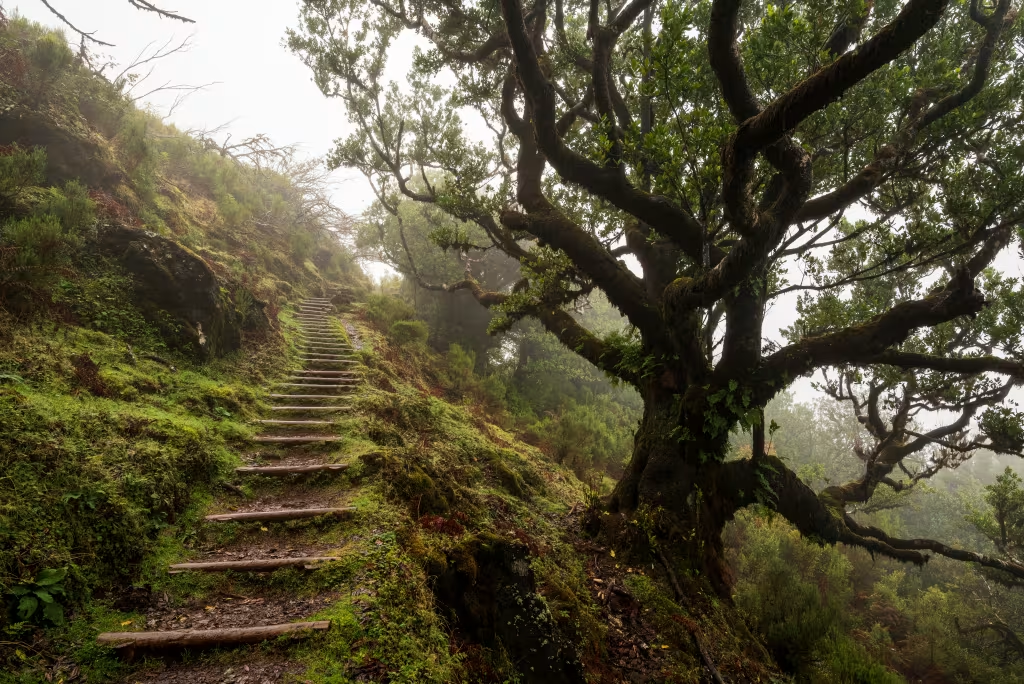
The scale of trees. The complexity of a forest floor. The way a river sounds when you stop walking and actually listen. These things were shaped over millions of years of evolution to produce exactly the feeling of scale and interconnection that psilocybin also happens to amplify.
They are, in this sense, extremely compatible.
The Boundary Problem
Here’s the more philosophical piece, and bear with it because it actually matters.
One of psilocybin’s most documented effects is a softening of ego boundaries, the sense of where “you” end and “everything else” begins. Under the influence, that line becomes permeable. Sometimes it disappears entirely, which researchers call ego dissolution, and which users tend to describe either as the most terrifying or the most profound experience of their lives, depending on how they met it.
But even at moderate doses, before anything gets dramatic, there’s a subtle version of this that almost everyone notices. The sense of self becomes less rigid. Less defended. More porous.
Being inside a room when this happens is strange. You’re surrounded by human-made objects, right angles, surfaces that exist specifically to keep the outside out. The architecture of the indoor world is, in a very literal sense, a monument to separation, between you and weather, you and other creatures, you and the rest of the living world.
When your sense of self has softened, that separation starts to feel arbitrary. Almost rude.
Outside, the boundaries are less enforced. There are no walls. The air moves through the same space as your body. The sounds arrive from everywhere at once. You are, technically and literally, in contact with the same environment as everything else that’s alive.
For a brain that is temporarily less certain about where it ends, this is a profound relief.
A study from Imperial College London found that patients who received psilocybin treatment reported significantly increased feelings of connection to nature in the months after the experience, not just during it. That shift in nature relatedness was still measurable a year later. Some participants reported changing careers to work in more environmentally conscious roles.
A larger follow-up study published in the journal Frontiers in Psychology, which pooled data from eight double-blind placebo-controlled psilocybin studies, found that 38% of participants reported enduring positive changes in their relationship to the natural environment eight to sixteen months after their experience.
Two doses. Lasting change. The forest got into them and stayed.
Mushrooms Grew There First
There’s also something worth sitting with that isn’t strictly neuroscience.
Psilocybin mushrooms are, of course, organisms. They grow in soil, under trees, from decomposing wood. They are part of the forest ecosystem in a way that is not metaphorical. They participate in the mycorrhizal networks that connect trees underground, share nutrients, and pass chemical signals across root systems. The mushrooms you take were, before they were anything else, part of a forest.
It is perhaps not entirely surprising that consuming them makes the forest feel like the right place to be.
Indigenous traditions that have used psilocybin mushrooms ceremonially for centuries, including the Mazatec people of Oaxaca, Mexico, where the modern Western rediscovery of psilocybin began in 1957, almost universally situate the experience in nature. Not because they lacked shelter, but because the natural world was understood as the appropriate container for this kind of opening.
Modern research is arriving at the same conclusion through a different door. A review published in Ecopsychology found that psychedelic experiences in natural settings consistently produced stronger feelings of nature connectedness and ecological concern than those conducted indoors, suggesting that where you are shapes not just the experience, but what it leaves behind.

A Note on Doing This Safely
The pull toward outside on mushrooms is real and worth honoring, but worth planning for.
If you’re considering a nature-based experience, familiar, private, low-foot-traffic environments work best. A garden you know well. A quiet park without crowds. A friend’s property. Somewhere you can sit with the trees without also managing strangers, traffic, or complex navigation.
Set and setting remain the most important variables in any psychedelic experience, a point emphasized consistently in MAPS-affiliated harm reduction guidelines. Outside is beautiful. Outside is also unpredictable. Know where you’re going before you go.
Research on the relationship between nature and mental health from Harvard’s School of Public Health also reinforces that even sober time in green spaces reduces cortisol, lowers blood pressure, and improves mood, meaning the setting itself is already doing therapeutic work before you factor in anything else.
If you’re newer to this and curious about starting gently, our Magically Microdosed Gummies are a thoughtful way to begin, low dose, easy to control, and genuinely lovely in a green space on a good day. For those further along in their journey, our Magic Mushroom Chocolate Bars offer a more intentional experience worth planning around.
The Thing the Forest Already Knows
You were not always inside.
For almost all of human history, the outside was the default state. Shelter was temporary, seasonal, incomplete. The air you breathed moved through the same forest as every other animal. You were not separate from nature. You were a part of it, inseparable, subject to the same rain and dark and light as everything else.
The feeling of coming home when you step outside on mushrooms is not an illusion the drug creates.
It’s a memory the drug uncovers.
Trip safely, know your source, and respect the experience. Visit SmilesHigh.Club for more.

Outside in the forest tho – that other post about being in the city on shrooms was crazy, smh
Nature def hits different on zoomies
everything feels alive
Being outside already feels calming, so I can see why mushrooms would make that feeling stronger.