
The Best Magic Mushroom Spotify Playlists
From a 1967 turntable at a Maryland psychiatric hospital to an Ecuadorian cave, the art of the trip playlist has become its own science.
Nobody tells you that the playlist matters more than the dose.
You’d think the drug would be doing the heavy lifting. You’re wrong. A 2018 study out of Imperial College London found that the quality of a person’s music experience during psilocybin therapy was a stronger predictor of reduced depression than how hard they actually tripped. The music wasn’t background noise. It was the medicine.
Which means somewhere right now, a scientist in a lab coat is very seriously thinking about whether to put Tame Impala before or after the Górecki.
They are. That’s a real job. And honestly? Good for them.
The Onset: You’re Still Pretending You’re Fine
The mushrooms just hit. You’re on the couch. You’re definitely fine. Everything is fine.
This is the moment for something unhurried and warm — music that isn’t going to startle you into thinking something has gone wrong, because nothing has gone wrong, you’re just noticing that your hands look extremely interesting. (If you want to know why that’s happening, we wrote a whole thing about it.)
Tame Impala’s Let It Happen is basically built for this moment. Eight minutes of swirling psychedelic pop that literally tells you, in the title, exactly what to do. Kevin Parker wrote the whole Currents album about surrendering to change. He did not know he was writing trip music. He was absolutely writing trip music.
Listen: Tame Impala — Let It Happen
The Johns Hopkins research team — who have been curating clinical psilocybin playlists since 1967, which is insane — recommend music at this stage that feels like it’s “picking you up and carrying you.” Something with forward motion. Something dependable. Their full playlist, built by psychologist Bill Richards over five decades of actual psychedelic research, ends with Louis Armstrong’s What a Wonderful World, which is either the corniest or the most genius closing track imaginable. Probably both.
Listen: Johns Hopkins Psilocybin Research Playlist
The Ascent: Okay, Something Is Definitely Happening
The walls are not breathing, exactly. They’re just more textured than before.
Here’s where you want something that opens up rather than closes down. Big, expansive, no sudden moves. This is the part of the trip where music doesn’t just sound good — it becomes architectural. You’re not listening to it anymore, you’re living inside it.
SZA’s 20 Something at this exact moment is genuinely one of the more vulnerable experiences available to a person. Something about her voice — that particular quality of sad-but-not-broken — hits completely differently when the walls between you and your own feelings have gone a bit soft. People have cried. Not sad crying. The other kind.
Listen: SZA — 20 Something
The clinical recommendation at this stage is to avoid lyrics altogether — the technical term is hermeneutic contamination, which is academic for “someone else’s words crashing your internal movie.” But SZA at the right moment? Sometimes contamination is the point.
If you want something to ease the ascent without the emotional ambush, our Magic Mushroom Chocolate Bars are dosed for exactly this kind of intentional, slow-building experience. Start low. Let it arrive.

The Peak: You Have Dissolved, Please Leave a Message
You are not a person right now. You are a feeling having a feeling. This is fine. This is great, actually.
The peak is where music stops being entertainment and becomes something closer to navigation. Bill Richards times Samuel Barber’s Adagio for Strings to arrive precisely here — a piece that builds to one of the most devastating climaxes in classical music and then comes back down, mirroring the biochemical arc of the trip itself. It works. It really, genuinely works.
But for those of us who find orchestral swells a bit much at 2am, Jon Hopkins went and made an entire album for exactly this situation. Music for Psychedelic Therapy was recorded partly in a cave in Ecuador — an actual cave, underground, in the Amazon — and it sounds exactly like that. Beatless. Enormous. Slightly ancient. The last track features Ram Dass whispering quiet the mind and open the heart over slow ambient chords, which would be unbearably cheesy in any other context and somehow isn’t.
Listen: Jon Hopkins — Music for Psychedelic Therapy
If you’re curious about what’s actually happening neurologically while you’re dissolved on the couch — why the peak hits the way it does, why fear sometimes walks in uninvited — this piece on how mushrooms rewire fear explains the brain circuitry behind it without making you feel like you’re back in biology class.
The Come-Down: Hello, I Am a Person Again, Theoretically
The geometry has mostly stopped. You are lying on the floor for reasons that seemed important earlier.
The return is its own art form. You need music that’s warm without being saccharine, present without being demanding. Something that says: you can come back now, whenever you’re ready, no rush.
Floating Points, Pharoah Sanders, and the London Symphony Orchestra made Promises in 2021 — nine movements built around a five-note motif that evolves so slowly and so beautifully you start to feel like time itself has opinions. Pharoah Sanders was 80 when they recorded it. It was his last album. Knowing that doesn’t make it sadder. It makes it more true.
And then there’s the undisputed come-down king: Aphex Twin’s Selected Ambient Works Volume II. Richard D. James has said he made it to sound like “standing in a power station on acid.” It sounds like being inside a dream you’re slowly remembering. It sounds like the quiet after everything. Thirty years old and it still sounds like nothing else on earth.
Listen: Aphex Twin — Selected Ambient Works Volume II
The come-down is also a genuinely good time for something warm and grounding — our Magically Microdosed Gummies are a lot of people’s go-to for exactly this landing phase. Gentle. Chocolatey. No drama.
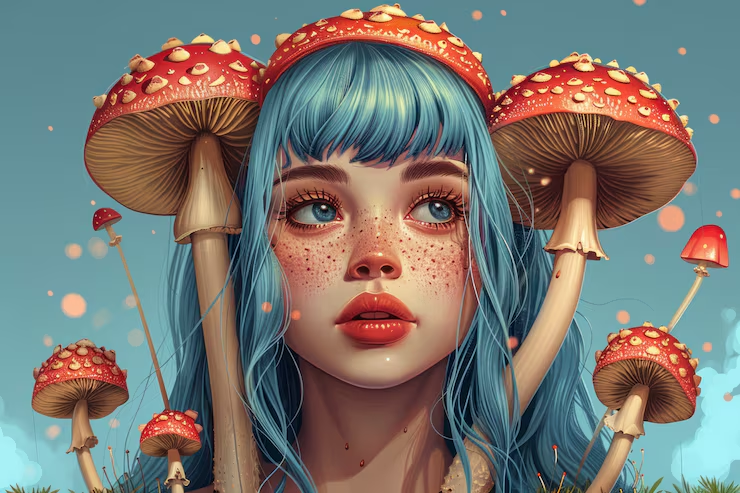
The Thing Nobody Says Out Loud
There’s a genre being invented right now, in hospital research centers and Ecuadorian caves and quiet apartments with good speakers. It doesn’t have a name yet. It’s not ambient, not classical, not neo-soul — it’s music designed specifically for the moments when a human brain is at its most open, most frightened, most capable of actually changing.
That’s not a small thing to make music for.
The scientists are taking it seriously. The musicians are taking it seriously. Maybe the playlist deserves a little more respect than we’ve been giving it.
Put the phone down. Choose carefully. Press play.
Trip safely, know your source, respect the experience. Browse our full range at SmilesHigh.Club.
— Lennox

Spotify playlists are dangerous because the algorithm will randomly decide it’s time for dubstep at the worst possible moment.
needs more stairway
I made a playlist once and forgot I added a Halloween sound effects track. Bad planning on my part.