Category Archives: Advice

I Microdosed Every Day for 30 Days. Here’s What Actually Happened.

Wooden letter blocks spelling out the word microdosing on a grey background, representing a 30-day psilocybin microdosing experiment and its effects on mood, creativity and mental health

I expected to become one of those people — sharper in meetings, warmer with strangers, sleeping eight hours without the ambient dread that usually wakes me up at 3am convinced I’ve forgotten something important. I expected a gentle, cumulative upgrade. A software update for a brain that had been running the same slightly buggy version for 27 years. I did not become one of those people. What happened instead was stranger, more boring, more useful, and significantly harder to put in an Instagram caption.

Why Do I Want to Be Outside on Mushrooms?

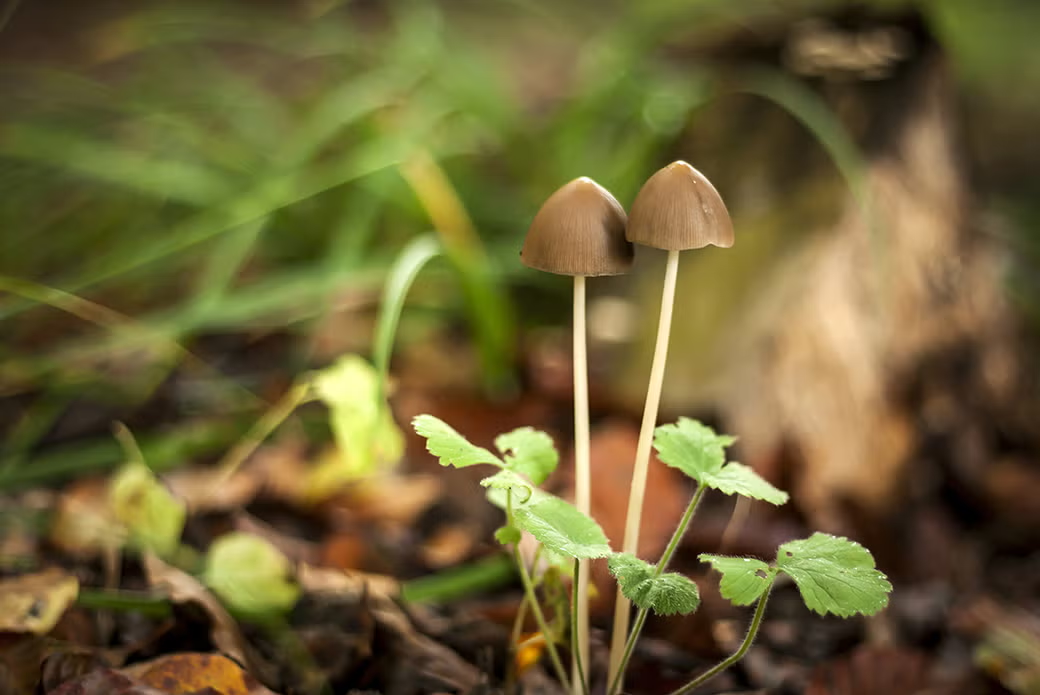
Wild mushrooms growing on a forest floor, illustrating the natural connection between psilocybin mushrooms and the outdoor environment during a psychedelic experience

There’s a moment that happens on mushrooms — usually somewhere between the onset and the peak — where the walls start feeling like a bad idea. Not threatening, exactly. Just wrong. Too flat. Too still. Too inside. Then you step outside, and the air hits you, and the trees are doing that thing where they’re just being trees, and something in your chest unlocks. It happens to almost everyone. And it isn’t random.

Why Your Second Trip Feels Nothing Like Your First

Illustrated graphic of magic mushrooms representing the neuroscience of why a second psilocybin trip feels different from the first

The first time is unforgettable. You didn’t know what to expect, so your brain had nothing to defend against. The visuals hit differently when you’ve never seen geometry breathe before. Then you went back — same mushrooms, same couch, same carefully assembled playlist — and something was off. Flatter. More work. Less magic.
What happened? Your brain remembered. And remembering, it turns out, changes everything. From receptor downregulation to the neuroscience of expectation, here’s exactly why your second trip felt nothing like your first — and what to do about it.

How to Sleep After a Mushroom Trip

Person resting in bed at night after a psilocybin mushroom experience, illustrating post-trip insomnia and recovery

Struggling to sleep after a mushroom trip is more common than most people expect. Even when the visuals fade and your body feels tired, psilocybin can leave the brain unusually alert. That’s because it stimulates serotonin receptors and increases neural connectivity rather than calming the nervous system. The good news? Post-trip insomnia is usually temporary — and there are simple, science-backed ways to help your body wind down naturally.

Why Can’t I Sleep on Magic Mushrooms?

Person lying awake in bed at night after taking psilocybin mushrooms, illustrating insomnia and post-trip stimulation

Many people are surprised to discover that magic mushrooms don’t make them sleepy — they make it harder to sleep. Even after the main effects fade, the mind often feels alert, reflective, and unwilling to power down. That’s because psilocybin stimulates serotonin receptors and increases overall brain connectivity rather than depressing the nervous system. If you’ve ever felt exhausted but mentally awake after a trip, there’s a clear neurological reason why.

Why Do I Stare at My Hands on Mushrooms?

Person examining their hands during a psilocybin mushroom experience, illustrating altered perception and heightened sensory awareness

Almost everyone who takes mushrooms has the same oddly specific experience: at some point, you end up staring at your hands. They look unfamiliar, detailed, almost fascinating in a way they never have before. This isn’t random. Psilocybin reduces the brain’s predictive filtering, making ordinary things feel novel again — and your hands, which sit at the center of identity and control, become the perfect object of attention. What feels strange in the moment is actually a window into how perception and self-awareness work.

Will I Have a Bad Trip on Magic Mushrooms?

Brain scan illustration showing altered neural activity under psilocybin, linked to ego dissolution and reduced default mode network activity

“Will I have a bad trip?” is usually code for a deeper fear: What happens if I lose control? Research shows psilocybin quiets the brain’s Default Mode Network — the system that maintains your sense of self and narrative control. For people who rely on structure, planning, and certainty to feel safe, that softening can feel destabilizing. Most difficult trips aren’t random; they’re friction between the experience and the part of you trying to steer. And sometimes, what feels like a bad trip is simply the moment control stops working — and something more flexible begins.

Why Mushrooms Don’t Care About Your Identity

Ancient church fresco depicting spiritual transcendence and the dissolution of ego, echoing themes of mushroom-induced self-reflection and interconnectedness.

I didn’t stop being a bully because I found compassion.
I stopped because mushrooms took away the lie that I was better than anyone else.

Mushrooms don’t care who you think you are. They strip you down to the organism underneath and remind you, bluntly, that everyone else is trying to survive the same invisible weight. Not in a “we are one” slogan kind of way — in a biological, unavoidable one.

This is the story of how taking too many mushrooms didn’t make me nicer overnight… it just made being unkind impossible to unsee.

Why Mushrooms Pair So Well With Therapy

Therapy helps us tell our stories more honestly — mushrooms help us hear them differently. From increased emotional openness to fresh perspective shifts, science is beginning to show why psilocybin and therapy can work so well together. This article explores the neurological, emotional, and psychological reasons mushrooms often deepen therapeutic work — and why integration matters more than the experience itself.

Microdosing Myths vs. Facts: What People Think vs. What the Science Actually Says

Microdosing capsules and dried psilocybin mushrooms spilling from a jar against a pastel gradient background.

Microdosing has taken the wellness world by storm, with promises of sharper focus, boosted creativity, and even relief from anxiety and depression. But how much of what we hear is based on science—and how much is simply wishful thinking? In this blog, we’ll break down the most common myths about microdosing and compare them with the latest research, so you can understand what’s fact, what’s fiction, and what still remains a mystery.