
Will I Have a Bad Trip on Magic Mushrooms?

The Personality Trait Most Likely to Have a Bad Trip
Before almost every first mushroom experience, there’s a quiet, tightening thought:
What if this goes badly?
Not what will I learn.
Not what will I feel.
Just: what if I lose control?
That question alone tells you something important.
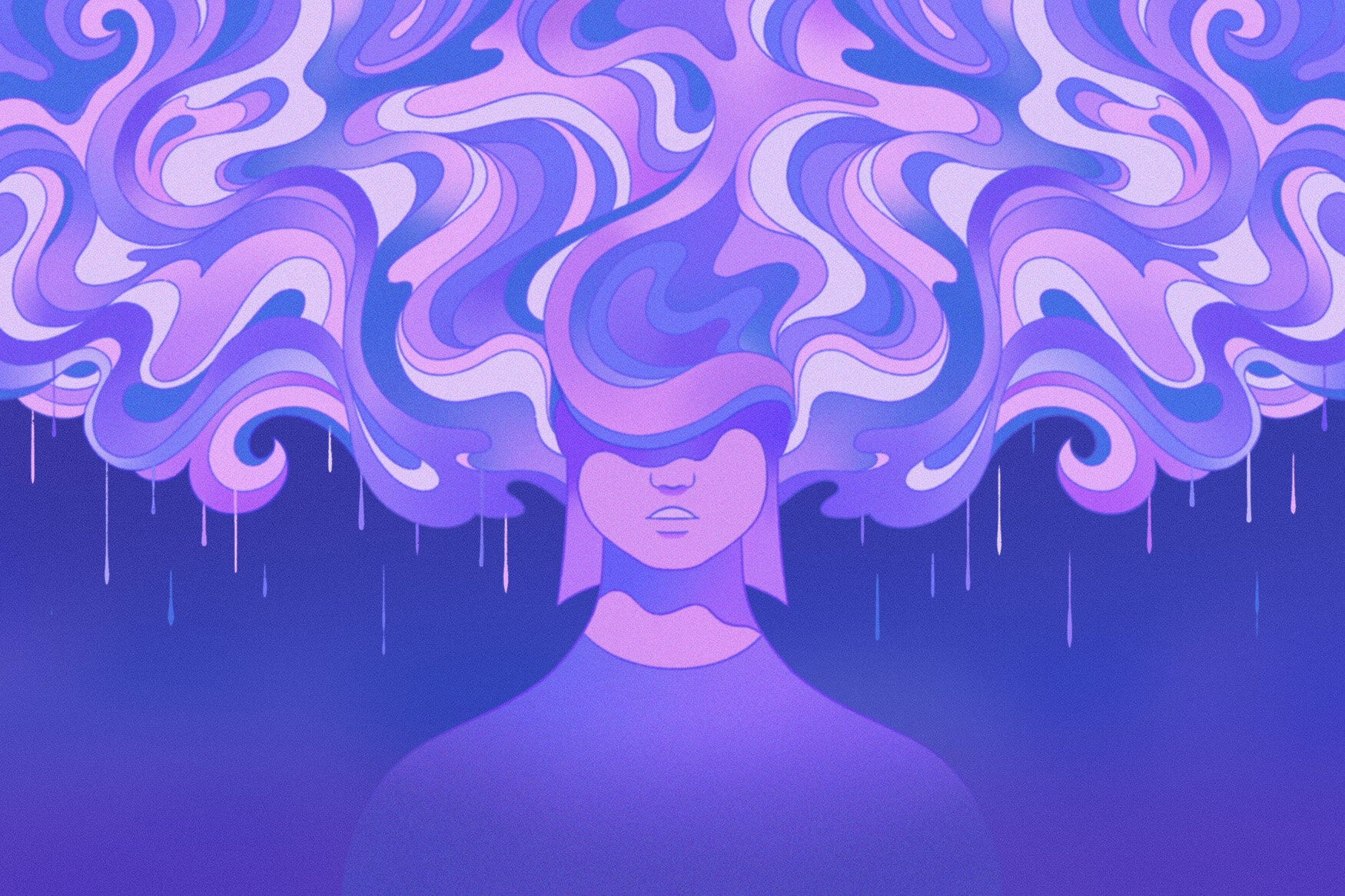
Because most so-called “bad trips” aren’t random lightning strikes from the psychedelic gods. They tend to emerge from friction — friction between the experience and the part of you that insists on steering.
And the personality trait most likely to feel that friction?
A high need for control.
The Brain on Letting Go
Psilocybin — the psychoactive compound in magic mushrooms — consistently shows reduced activity in a brain network called the Default Mode Network (DMN).
The DMN is heavily involved in self-referential thinking: your inner narrator, your sense of identity, your mental rehearsal of the future, your replay of the past. It’s the system that keeps the story of “me” running in the background.
Research from Imperial College London and Johns Hopkins has shown that psychedelics temporarily decrease activity and connectivity in this network, which correlates with experiences of ego dissolution and reduced rigid thinking patterns.
-
Carhart-Harris et al., PNAS (2012): https://www.pnas.org/doi/10.1073/pnas.1119598109
-
Johns Hopkins Center for Psychedelic & Consciousness Research: https://hopkinspsychedelic.org
For some people, this quieting feels expansive. Liberating. Spacious.
For others, especially those who rely on mental control as a stabilizing force, it can feel like the floor dropping away.
The Control Personality
There’s a type of person who tends to struggle more during psychedelic experiences.
They are competent. Organized. High-functioning.
They anticipate problems before they happen.
They are rarely caught off guard.
Control, for them, is not vanity. It’s safety.
In everyday life, this trait is rewarded. It builds careers. It earns trust. It keeps chaos at bay.
But mushrooms temporarily remove the dashboard.
You cannot optimize a mushroom trip.
You cannot outthink it.
You cannot muscle it into compliance.
And when the instinct to “fix” or “regain control” kicks in, anxiety often follows.

What Research Says About “Challenging Experiences”
A large survey study published in Journal of Psychopharmacology examined over 1,900 difficult psilocybin experiences. While many participants rated their trips as among the most challenging events of their lives, a majority also reported long-term positive outcomes from them.
Notably, resistance and fear of losing sanity were common themes during difficult experiences — especially when users felt they couldn’t surrender to the altered state.
-
Carbonaro et al., Survey study of challenging experiences after psilocybin (2016): https://journals.sagepub.com/doi/10.1177/0269881116662634
The key pattern wasn’t dosage alone. It was psychological stance.
When people tried to fight the experience, distress increased. When they allowed it to unfold, even intense moments often transformed.
This aligns with decades of psychedelic research emphasizing “set and setting” — your mindset and environment — as primary determinants of outcome.
-
Zinberg, Drug, Set, and Setting (1984)
Mindset includes personality traits. Including the need for control.
Perfectionism and the Fear of Uncertainty
Psychology research outside the psychedelic field consistently links high intolerance of uncertainty and rigid perfectionism with anxiety sensitivity.
In simple terms: the more you rely on certainty to feel safe, the harder uncertainty hits.
-
Dugas et al., Intolerance of Uncertainty and Anxiety (2004)
Psilocybin amplifies uncertainty. Time bends. Sensory perception shifts. Thoughts become nonlinear. Your usual internal map doesn’t apply.
For someone comfortable with ambiguity, this can feel fascinating.
For someone who equates ambiguity with danger, it can feel threatening.
That’s where the “bad trip” often begins — not in the visuals, not in the intensity, but in the resistance.
The Paradox: The Lesson Is the Letting Go
Here’s the irony.
People with a strong need for control are not doomed to have bad trips.
In fact, they often have the most transformative ones.
Because when the grip finally softens — even slightly — there’s a profound realization:
You don’t have to hold everything together all the time.
Many therapeutic models now exploring psilocybin-assisted treatment (for depression, addiction, and end-of-life anxiety) emphasize this exact mechanism: flexibility. The loosening of rigid cognitive patterns.
-
Griffiths et al., Psilocybin produces substantial and sustained decreases in depression and anxiety (2016): https://pmc.ncbi.nlm.nih.gov/articles/PMC5367557/
Control isn’t the enemy. Rigidity is.
And mushrooms are, if nothing else, agents of psychological flexibility.
So… Will You Have a Bad Trip?
The better question might be:
How do you respond when you can’t control something?
Do you tense?
Do you fight?
Do you catastrophize?
Or can you breathe and let weather pass?
Mushrooms don’t create your fears. They reveal your relationship to uncertainty.
Sometimes what gets labeled a “bad trip” is simply the moment your usual coping strategy stops working.
And sometimes, that’s exactly where the growth begins.
Back to the safety of SmilesHigh.Club

A really good blog and me back again.
it’s been said on here, but I’ll say it again – just take less! Then, when they haven’t hit after an hour… WAIT!!!! Because you know that as soon as you take that 2nd dose, your first dose is gonna hit, then BLAM! DoubleDose
a bad trip is just a good trip you haven’t met yet!